

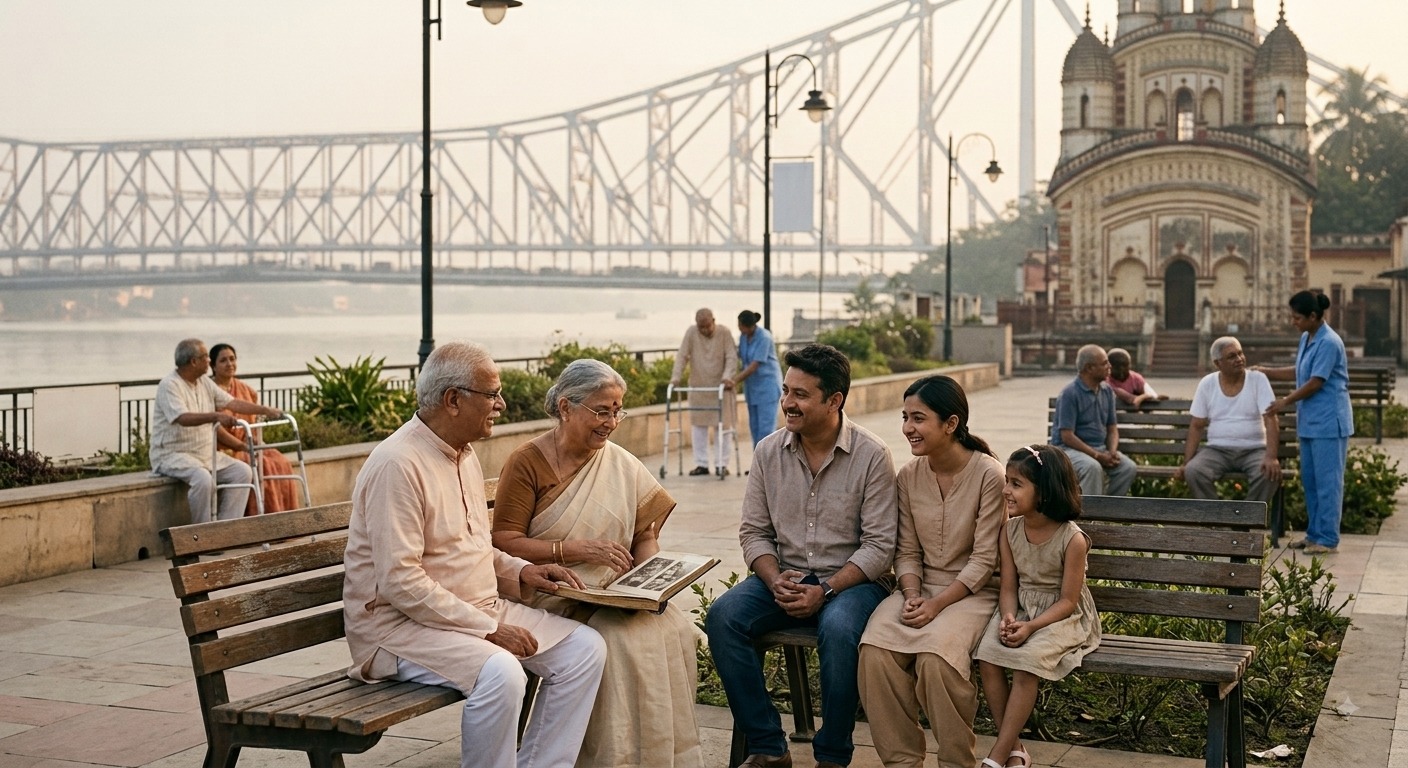
Retirement Homes in Kolkata: What Families Are Really Looking For
The Morning That Changes the Whole Conversation
Picture this. A woman in her early sixties, tea in hand, standing on a balcony overlooking the Hooghly. She's not waiting for a nurse to check on her. She's deciding whether to join the sunrise yoga group on the ghat or head straight to the art studio, because her watercolour class starts in an hour and she still hasn't finished last week's piece.
That's not a scene from a wellness resort brochure. That's an ordinary Tuesday in a well-designed senior living community in Kolkata today.
Most families still picture something very different when they hear "retirement home." They picture a fallback, a place for when things get harder. That picture is outdated, and it's costing a lot of retirees years of a life they could be living fully right now.
Let's talk about what retirement homes in Kolkata actually look like in 2026, and why the smartest move a family can make is stopping the search for "somewhere safe" and starting the search for "somewhere alive."
Why the Old Idea of Retirement Homes in Kolkata No Longer Fits
For decades, the phrase "old age home" carried a certain weight in Kolkata. Functional buildings. Quiet corridors. A place people moved to reluctantly, usually after something had gone wrong.
That perception is fading, and fast. Today's 55 to 70-year-olds are a different generation entirely. Many have run businesses, travelled, raised financially independent children, and built real wealth. They are not looking for a fallback option. They are looking for their next chapter.
As Keshav Agarwal, Director of Srijan Realty, put it, Kolkata's residential conversation is maturing. Today's seniors are not downsizing. They are right-sizing, choosing homes that match the life they actually want to live now, not the life they're leaving behind.
That single shift in mindset is why retirement homes in Kolkata are being redesigned from the ground up, from institutional efficiency to something closer to a resort with a purpose.
What Today's Retirees Actually Want
In my years of working with families across Kolkata, the wish list has changed dramatically. Nobody asks me anymore, "Will someone be there if something happens?" That's assumed. What they actually ask is far more interesting:
- Will I have people to talk to who understand my pace of life?
- Can I still cook if I want to, or eat what I want, when I want?
- Is there a river, a garden, or open air nearby, not just a parking lot view?
- Will there be things to actually do, not just things to attend?
- Can my grandchildren visit and enjoy the space too?
This is where a well-designed senior living community, like Primus Ganges within Srijan Ganga City, changes the equation. Set along nearly three kilometres of Hooghly riverfront, the community was built around the idea that aging well has less to do with medical support and everything to do with movement, connection, and a sense of purpose.
A Day That Looks Nothing Like "Retirement"
If you picture retirement as sitting quietly on a veranda, it's worth seeing what an actual day looks like in a modern senior living setup.
Mornings often start with sunrise yoga by the river or a quiet walk along the ghat. Breakfast is chef-curated and nutritionist-approved, not because residents can't cook, but because they've earned the right not to have to. Afternoons might involve an art class, a music club, or simply reading in a shared library with a view of the water.
Evenings bring something Kolkata seniors have always valued but rarely had access to in one place: community. Terrace dinners, Ganga Aarti in the evening light, hobby groups, and conversations with neighbours who share similar life experiences and similar energy.
This is the Blue Zone philosophy at work, the same principle behind the world's longest-living communities: movement, purpose, and social connection matter more than any single medical intervention. Communities inspired by this idea don't market themselves around illness. They market themselves around living.
Choosing Retirement Homes in Kolkata: A Quick Comparison
Families often ask how to tell a genuinely good senior living option from one that's simply repackaged the old model with a fresh coat of paint. Here's a simple way to evaluate what you're seeing.
| What to Look At | Old-Style Old Age Home | Modern Senior Living Community |
|---|---|---|
| Design philosophy | Institutional, hospital-like | Warm, home-like, senior-friendly without feeling clinical |
| Daily structure | Passive, routine-based | Active, with wellness, hobbies, and social events |
| Healthcare | Reactive, called in when needed | Preventive, with regular monitoring built into daily life |
| Food | Standardised meals | Chef-crafted, nutritionist-guided, often flexible |
| Social life | Limited or optional | Central to the experience, with clubs and communal spaces |
| Family involvement | Occasional visits | Encouraged visits, multi-generational spaces, guest stays |
| Location | Often tucked away | Increasingly riverside or green, within reach of the city |
If a place you're considering leans heavily toward the left column, it's worth asking harder questions before signing anything.
Where Location Still Matters
One thing families underestimate is how much geography affects daily happiness. A retirement home an hour away from every familiar landmark can quietly become isolating, no matter how nice the interiors are.
This is one reason developments within larger townships have an advantage. Primus Ganges, for instance, sits inside the 55-acre Srijan Ganga City in Maheshtala's Batanagar, roughly 35 minutes from central Kolkata via the Sampriti Flyover. Close enough for children to visit on a Sunday afternoon, far enough to trade city noise for river air.
Residences here range from studios to 1 BHK and 2 BHK homes, from around 500 to 1,311 square feet, each with a balcony and thoughtful senior-friendly details like anti-skid flooring, grab rails, and emergency response systems. None of it feels like a hospital. It feels like a well-designed home that happens to keep you safer.
Common Myths Families Should Let Go Of
I've heard every version of hesitation over the years. A few myths deserve to be retired for good:
- "Moving means giving up independence." Well-run communities are built around preserving independence, with support quietly available only when wanted, not imposed.
- "It's only for people who need care." Most residents in modern communities are active, mobile, and simply prefer not to manage a large house alone anymore.
- "It will feel lonely." In practice, families often report the opposite. Structured social life and shared interests create friendships that many say they hadn't experienced in years.
- "It's a compromise, not a choice." For a growing number of Kolkata's seniors, it's the first time in decades they're choosing a lifestyle purely for themselves.
How to Start the Conversation With Your Parents
If you're the one researching retirement homes in Kolkata on behalf of a parent, the framing of that first conversation matters more than any brochure. Lead with curiosity, not concern. Ask what a perfect week would look like for them now that responsibilities have eased. Visit a few communities together rather than presenting one as a decision already made.
Most importantly, let them see it as an upgrade to their lifestyle, not a downgrade in their independence. That shift in framing, more than any amenity list, is usually what changes minds.